
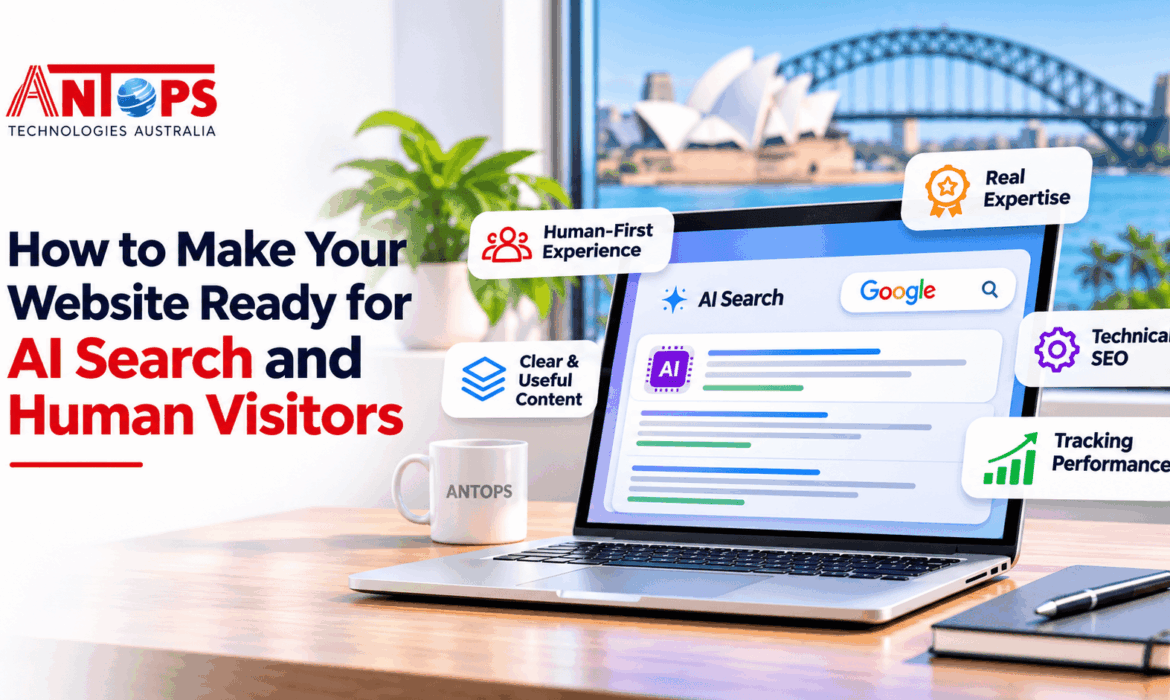
AI-powered search is changing how people discover information online. Instead of simply typing a few keywords into Google and scanning a list of results, users can ask detailed questions and receive conversational answers.
For businesses, this creates an important challenge: How can a website remain useful to humans while also being easy for modern search systems to understand?
The answer isn’t to create content specifically for machines. A stronger approach is to build a website around clarity, expertise, accessibility and genuine user needs.
Start With the Human Visitor
AI search may be changing the technology behind discovery, but people are still the audience.
Before making technical changes, look at your website from a customer’s perspective.
Can someone understand what your business does within a few seconds? Can they find the information they need? Is the next step obvious?
If visitors have to search through multiple pages to understand a service, AI optimisation won’t solve the underlying problem.
A useful website should make information easy to find and easy to understand.
Answer Questions Clearly
People increasingly search using questions rather than short phrases.
Instead of:
“web development Sydney”
someone might ask:
“How much does a business website cost in Sydney and what should it include?”
Websites can prepare for this behaviour by addressing genuine customer questions through service pages, FAQs, guides and educational content.
The key is to provide complete answers rather than creating separate pages for every variation of the same keyword.
Demonstrate Real Expertise
AI systems have access to enormous amounts of information. Generic content therefore has little reason to stand out.
Businesses can differentiate themselves through first-hand knowledge.
This might include:
- Original research
- Case studies
- Expert opinions
- Industry examples
- Customer insights
- Practical experiences
- Unique data
For example, a digital marketing agency could explain how a particular campaign was structured, what challenges appeared and what lessons were learned.
This gives visitors something they cannot get from a generic article rewritten from other websites.
Build Clear Topic Relationships
A website should not feel like a collection of unrelated pages.
Related subjects should be connected through logical internal links.
For example, a website discussing SEO could connect an article about technical SEO with pages about website audits, content optimisation and local search.
This helps visitors explore related information and gives search engines additional context about the relationship between topics.
Make Important Information Easy to Access
Don’t hide critical information inside complicated layouts.
Your key services, locations, pricing information where appropriate, contact details and frequently asked questions should be easy to find.
Clear headings and concise sections also help visitors scan content quickly.
This is particularly useful for mobile users, who may be looking for one specific answer while on the move.
Strengthen Technical SEO
AI search doesn’t make traditional technical SEO irrelevant.
Search systems still need to access and interpret website content.
Businesses should continue monitoring:
- Indexing
- Crawlability
- Page speed
- Mobile usability
- Internal links
- URL structure
- Redirects
- Structured data
- Broken links
A technically healthy website gives search engines a clearer understanding of what each page contains.
Don’t Write for AI at the Expense of People
One of the easiest mistakes to make is over-optimising content for search systems.
Excessive keyword repetition, awkward headings and unnatural writing can make an article difficult to read.
If a sentence sounds like it was written for a machine rather than a customer, it probably needs rewriting.
Clear, natural language generally serves both audiences better.
Keep Business Information Consistent
AI-powered search can draw information from different online sources.
Businesses should therefore make sure important information is consistent across their website and legitimate business profiles.
This includes the business name, contact information, locations, services and other important details.
Inconsistent information can create confusion for customers and search systems alike.
Improve Your Website’s User Experience
A technically strong website can still fail if visitors don’t enjoy using it.
Pay attention to:
- Page loading speed
- Navigation
- Readability
- Mobile layouts
- Forms
- Calls to action
- Accessibility
- Visual hierarchy
A visitor should never have to fight the website to complete a simple task.
Track What Visitors Actually Do
Analytics can reveal whether the website is doing its job.
Look at which pages attract visitors, how people move through the website and where they leave. Conversion tracking can show whether traffic is producing enquiries, purchases, bookings or other valuable actions.
These insights can help businesses improve both their SEO and user experience.
Prepare for AI Without Chasing Every Trend
AI search will continue to evolve, and specific features may change over time.
Instead of constantly rebuilding your strategy around the latest development, focus on fundamentals that are likely to remain valuable: useful information, genuine expertise, technical accessibility, clear structure and a good user experience.
For Australian businesses working with an SEO Company Australia, this means developing a strategy that considers traditional search, AI-powered discovery and the human experience together.
Build for People, Optimise for Discovery
The best preparation for AI search isn’t a collection of tricks designed to make a website appear in an AI-generated answer.
It’s a website that deserves to be found.
When a business provides clear answers, demonstrates real expertise, maintains strong technical foundations and makes information easy to access, it creates a better experience for customers while giving search systems more useful information to understand.
In the long run, that combination is likely to be far more valuable than trying to predict every change in AI search.

